

I first came across Gideon Baeza’s work a few months ago, early on in the summer, when I saw a post on the NoBudge instagram account advertising a short film he’d made, titled Hope is Hip. Something about the seemingly banal, but colorfully lush stills included in the post piqued my curiosity, so I decided to give Gideon’s 10-minute film a shot. Despite my lack of knowledge in the field of skateboarding, something about this brief look into the life of a teenage skater almost immediately captivated me. The film’s calm, introspective, almost voyeuristic tone made me wonder whether I was watching a documentary or a fictional narrative, and both the film’s seemingly improvisational nature and color grading reminded me of indie films from the turn of the century, like Lisa Cholodenko’s High Art and Gus Van Sant’s Elephant.
I reached out to Gideon to share my thoughts on the short and it turned out that he was actively working on producing the a feature-length version. I had a growing impression that Gideon was onto something special with Hope is Hip, and that’s why, when I had the opportunity to interview the director on the week of his short film’s premiere at The Downtown Festival in New York City, I jumped on it.
A few hours before said screening of Hope is Hip at The Downtown Film Festival, Gideon Baeza joins ODDCRITIC to discuss his love for filmmaking and skateboarding, what it was like growing up in Midcoast Maine, and his aptly-titled feature-length debut.

Skateboarding as an Escape
Gideon begins our conversation by telling me a bit about his upbringing, and how he came to develop an interest in filmmaking at a young age. “From an early age I was in a creative household,” Gideon tells me, “and I would kind of say I wanted to be a director and work in film before I really knew what that was.” Having grown up with parents who were actively interested in art, specifically a cinephile for a mom and a graphic designer for a dad, it was only natural for the 26-year-old to follow in their footsteps, going as far as collaborating with his father on some of his projects. “He’s always been my collaborator since I started making stuff, he’s done all the titles and graphics for everything I’ve ever done.”
Moving on to how he got into skateboarding, Baeza tells me about the YMCA-owned teen center that was near his middle school, where kids would go to hang out after class. “They had a skatepark in the back of the building,” Gideon explains with a slightly nostalgic twang in his voice, “and I remember I forged my mom’s signature and rollerbladed the first day because that was the only thing they had available there for me to put on.” He goes on to explain that he developed an interest in skateboarding after seeing one of his good friends doing it. “I started coming to the teen center more regularly to go skateboarding, and immediately I just fell into it. It was just one of those things where I was like a 13 year old spending all my time outside skating and hanging out with people who became my best friends in high school.” Gideon further explains that he began to marry filmmaking and skateboarding when, inspired by skate content on YouTube, he started filming and editing his own videos of friends doing tricks on their boards.
Gideon goes into more detail as to why he’s so attached to the sport. “For me and my relationship with skating, it’s always been an escape for me. […] skateboarding has always been that one thing I could latch onto for comfort.” Whether he’s in Camden, Boston, L.A., or New York, Gideon feels like skating is where he can go to be himself, and that the culture that surrounds it has directly inspired his sensibilities and taste in fashion.

Reimagining the Skate Movie
Now discussing how Hope is Hip came to be, Gideon tells me about the inspirations and motivations behind the project. “I’d just been thinking about this idea of wanting to tell this story about skateboarding because I felt like I hadn’t seen a skate movie that accurately depicts skateboarders outside of the classic skater tropes, or [the main character wanting to be a pro-skater].” He makes a reference to Larry Clark’s Kids as a film that accurately depicts the raw, often vulgar nature of skate culture. Gideon not only wanted to make a film about skating, he wanted to make one about his relationship with his hometown of Camden, Maine and some of the friends he grew up with who still live there.
“I wanted to tell a story that was about growing up in a really small town and not feeling like you have the opportunities to leave, or the comfort and complacency of living in a place like that, where it’s so easy to just stay there and live there for the rest of your life.” He said he wanted to make a coming-of-age film that was about skating and growing up in a place like Camden, but not feeling like it’s an easy place to leave. Despite this, he also tells me that he knows that now more than ever, it’s hard to take that leap of faith and move somewhere else without a strong reason to. “I’m surviving in New York, but things are unpredictable right now, there’s no job security and moving here isn’t something that’s easy and accessible to people. That’s why a lot of creatives that are trying to make it in any artistic industry are working constantly, trying to find a way to stay afloat and spending the rest of their time working in a studio, or not even in a studio, their bedroom, their 800 sq. ft. bedroom.”
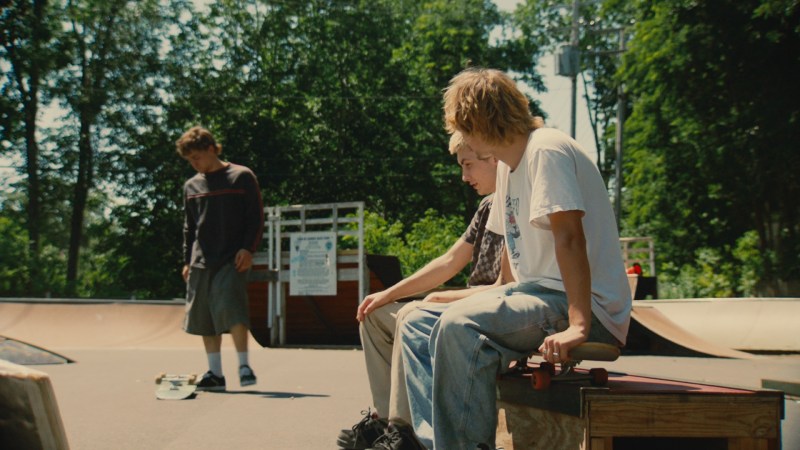
Now discussing the production of his proof-of-concept, Gideon explains how he chose to cast his protagonist, Travis Dube, for the project. Singing Travis’s praises, Gideon tells me about how Travis had a sort of magnetic pull that made people gravitate towards him. “I could immediately tell when I started seeing this kid skate, and the people that surrounded him, that this was the new generation of skaters in Camden, and Travis was pretty clearly the frontman of it. […] There was just something about him that I was sort of enamored by.” Gideon tells me that he also cast the rest of the skaters in a similar fashion to Travis, and his method of using non-actors gives the short a very raw, naturalistic appeal that makes it quite charming.
Baeza explains that the goal of his short film is for us to sympathize with these skaters who you can’t help but fall in love, even though they’re making seemingly bad choices. “Or are those choices bad?” Gideon asks me rhetorically. “Stealing, doing drugs, whatever else. Are those things inherently bad, or are these kids just trying to find their way, and it’s normal for a 16- or 17-year-old to do those things in their adolescence?” Gideon brings up a scene at the end of the film where Travis’s character is encouraging a younger skater to keep at it, and keep the skatepark alive. “That’s everything Travis cares about as a person,” Gideon says. “There isn’t someone who loves skateboarding more than he does, and more than anything it’s because he sees how valuable skateboarding has been in his life, and he wants to encourage younger kids to pursue skating for the sake of having that kind of outlet. He just cares about it deeply.”
Growing Up in Maine
Stepping away from the film for a bit to discuss our shared backgrounds as kids of color growing up in primarily white spaces, our conversation takes a more serious turn and Gideon tells me a bit about his ethnic background. “Maine’s the whitest state in the country, and it’s extremely homogeneous. My mom immigrated to this country from Cuba when she was a kid, and my grandfather on my dad’s side immigrated from Chile and met my grandmother who lived in Maine.” Gideon explains how it felt a bit weird moving to Maine at 10, because he already had family history there that dated back decades, yet he looked Cuban. “Even if I might be passing in a place like New York, I was the hispanic kid in Maine.” He continues by explaining how, at times, he felt ostracized for being Hispanic. “It made sense for me to want to leave because I knew that I was not surrounded by any sort of diversity in Camden. I love this place so much, it offered me so much, and a lot of kids would probably kill for the kind of childhood that I had, but I needed to be in a place with like-minded people.” Ultimately though, he tells me he looks back on his time in Camden fondly, and that being able to hover between Maine and New York feels like the best of both worlds. “I have a good relationship with home, so the fact that I can go back there and it’s contrastingly different from New York is nice. It makes me see both places in better lights.”
Making an Independent Feature
Going back to Gideon’s work on Hope is Hip, we now discuss the feature-length version, for which Gideon filmed principal photography over the course of three weeks this past summer. I ask how much of the film is inspired by Gideon’s own experience as a skater in Camden, which leads to us talking about the autobiographical nature of Hope is Hip, while also discussing the inherent differences between it and Baeza’s real life. “I’d say it’s mostly autobiographical, but I didn’t want to write a story where Parker, who’s the protagonist in the feature, is me. Everything I’d written was pulled from things that have happened in my life, but as I started writing this character, Parker really became his own person.” According to Gideon, Parker is someone who, at the beginning of the feature, is very directionless and passive in his decision-making—and the filmmaker tells me this is very different from he himself is in real life. “I’ve always been a very decisive person, headstrong, sure about what I wanted to do, and this character is the complete opposite.” Some experiences though, were pulled from Baeza’s real life. “In one scene, Griffin [Neal]’s character August, who’s the bad boy in the proof-of-concept, gets told by an officer to stop skating on the sidewalk, which is a true story. When I was a kid growing up, you couldn’t skate downtown.”

Gideon tells me about the toll that filming the feature took on him. He explains that directing this movie has been one of the hardest things he’s ever done, which he feels might be hard to comprehend for non-artists. “It may be partially true that I’ve had to deal with more difficult tasks in my life, but shooting a feature nowadays just feels like an impossible thing.” Baeza elaborates by explaining how the lack of federal funding towards filmmaking, and difficulty finding producers willing to fund a project like this from a first-time director, are just some of the many barriers to entry he had to overcome in order to make Hope is Hip. “I’d spent the past couple of years prior to this feeling unsure about what I was gonna do, in the sense that I knew I loved directing and that’s what I really wanted to do, but I didn’t know if that was me making narrative films, or documentaries, or me being a commercial director. I was unsure for a period of time if it was actually feasible for me to be a narrative director.”
Despite all of these hurdles, the filmmaker ultimately did manage to find a solution, in true indie filmmaking fashion. “Me and Marta [Denny] tried to figure out ways to get money, and I’d decided to make this thing for $50K. I told myself that if I couldn’t make this money, I’d put up the rest of it.” Gideon also informs me that the reason why he felt like he couldn’t spend more time raising money is because his metaphorical clock was ticking. “I felt like I couldn’t take more time to raise money and that it had to be now, because these kids were 18, 19, 20, and who knows where they’ll be in a year.”

Staying true to his word, Gideon amassed $5K through GoFundMe and then put up the rest of the money himself. I ask him if he feels like that was a good financial decision, and he seems definitive in his reply that it was, telling me that this wasn’t just a random, heat-of-the-moment decision. “I’ve been smart with saving money over the years because I knew that at some point I would need to invest my money into something like this. The fact that I’ve been able to make what I’ve made, especially with the money that went into it, I honestly feel like I just pulled off a heist.” On the flipside, he reminds me that Hope is Hip is much more than the money that went into it. “It truly made a difference for the actors and the crew who were a part of this, especially the actors. It changed my life but it totally changed a lot of these kids’ lives. What makes this film successful is that I don’t have a fancy rig and G&E team. It was me, my cinematographer, sound person, AD, and two producers. It was a small team of people.”
Nearing the end of our interview, I ask Gideon what he hopes for in regards to the post-production of this movie, and the subsequent distribution of it. “Right now I’m thinking on a smaller scale. I’m so excited to just share this, even just locally next summer, on the midcoast, in New England, that already is gonna be so exciting and give me so much.” He does still have big aspirations for this film though, and he tells me he wants to make it as big as he can make it. “I think more than anything as a filmmaker you want to share your project with as many people. I have the biggest hopes and dreams with this project, and it helps too that the film is kind of centered around that. Wishful thinking and stuff like that.” Going back to the subject of the film’s star, Travis Dube, Baeza tells me that being able to bring him to New York and to introduce him to his own world outside of skateboarding and line-reading is a reminder of what the film is about. “The fact that I can be affecting this kid’s life as much as he’s affected mine has been a really amazing thing.”
We close off the conversation by talking about Baeza’s plans for the future, and what he has in store for us. “Funnily enough, I feel like before this project I was thinking a lot about the next ten years of my life, what I wanted to accomplish in my life, or where my career was heading, my place in the industry.” Now that he’s been able to accomplish his lifelong dream of directing a feature, Gideon tells me he’s not thinking about that as much. “I’m less concerned about my next ten, twenty years. I’m really just thankful for what I have now and making the most of that instead of thinking of how I need to support myself in ten years.” The 26-year-old tells me that, even though he knows he wants to do this again, he considers himself fortunate enough to have other interests in his life. “[…] I don’t want to just have film be my life. Me being on the other side of shooting this film means I have the time to recenter myself, explore other, non-film related things.” Moving forward, he knows he definitely wants to make more projects, although he’s not entirely sure when that’ll happen. “Could be right after this, could be in ten years when I get another opportunity. Who knows when? I’m not necessarily gonna try to force anything. If opportunities come to me, I’m gonna take those. That’s kind of how I feel.” On a parting note, though, Gideon lets me in on a little secret. “I’d be very surprised if the world didn’t see a Gideon Baeza rom-com in the future.”
——
Watch Gideon’s short film Hope is Hip on NoBudge
All Images Courtesy of Gideon Baeza


